Playing ATF22V10C
2026-05-17
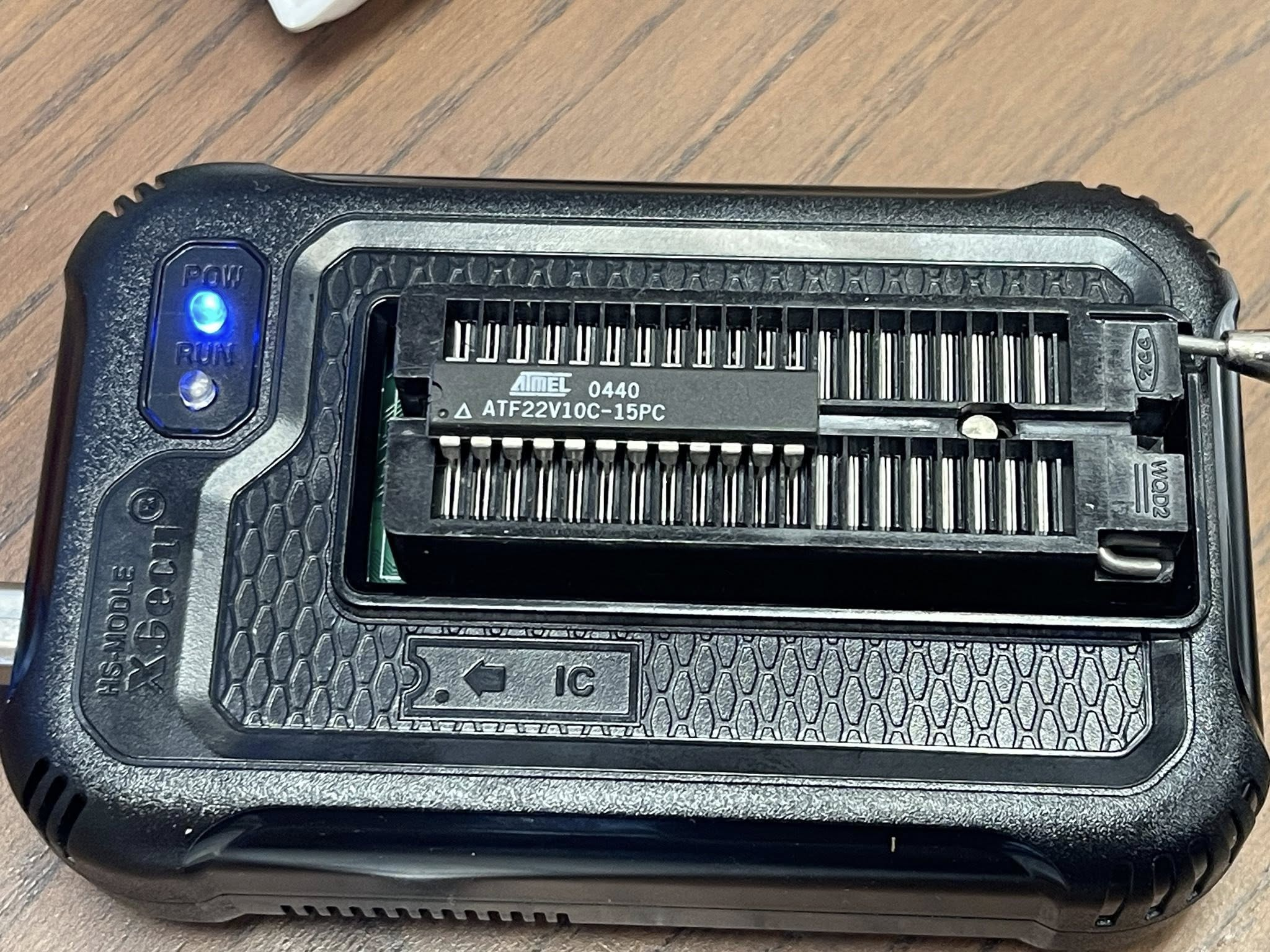
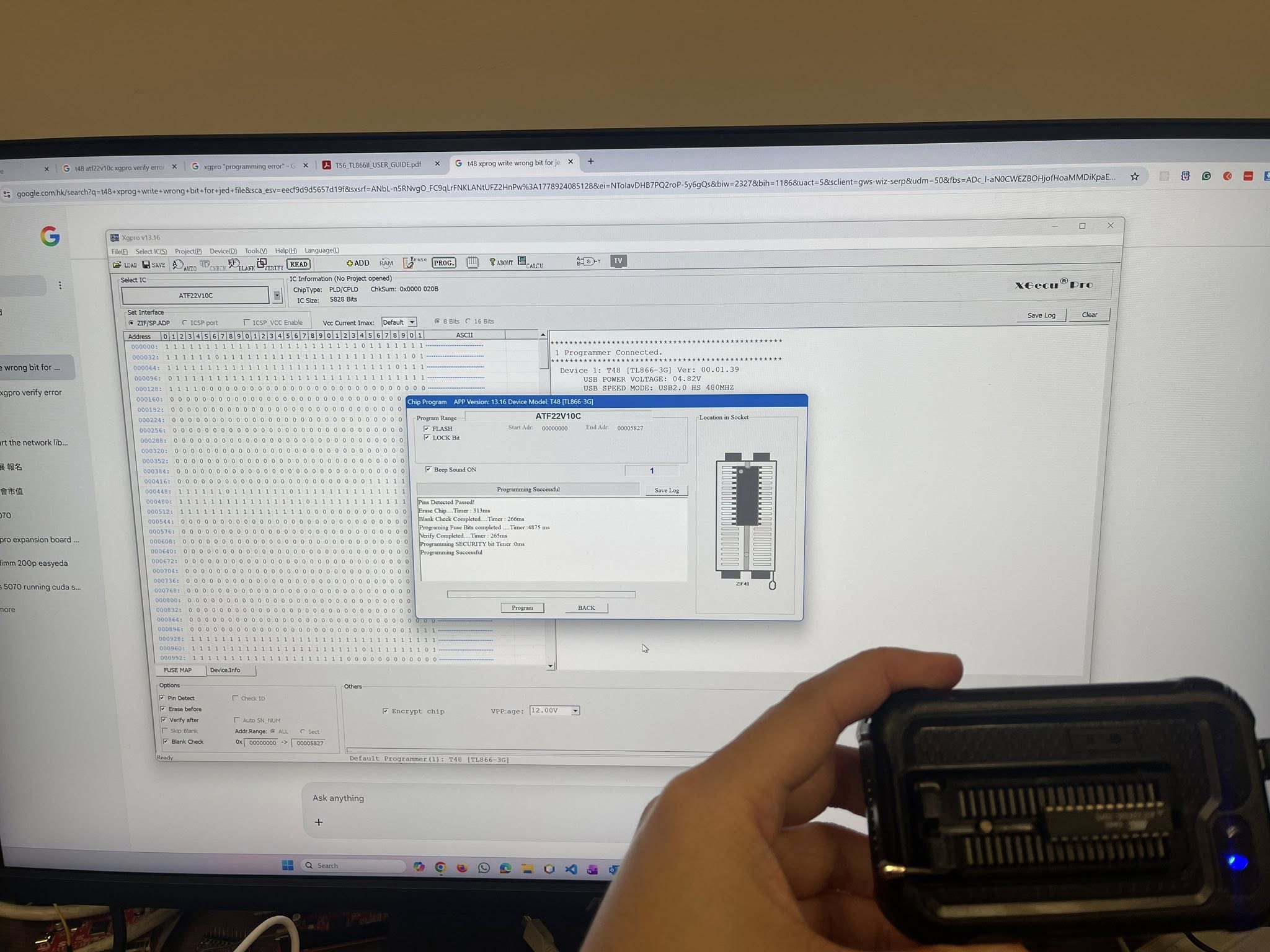
I bought 10 ATF22V10C from here and T48 programmer here, got 1 broken. First, here is the simple and gate program, save it to and.pld
GAL22V10
AND_Gate

Clock A  B  NC NC NC NC NC NC NC NC GND
NC    NC NC NC NC NC NC NC NC NC Y  VCC


Y = A * B			; AND gate: Y is high only when both A and B are high


DESCRIPTION
Simple 2-input AND gate example using a GAL22V10.
Inputs:  A (pin 2), B (pin 3)
Output:  Y (pin 23) - combinatorial output
Build galasm and minipro. Then compile and burn it by:
galasm and.pld
minipro -p ATF22V10C -w and.jed
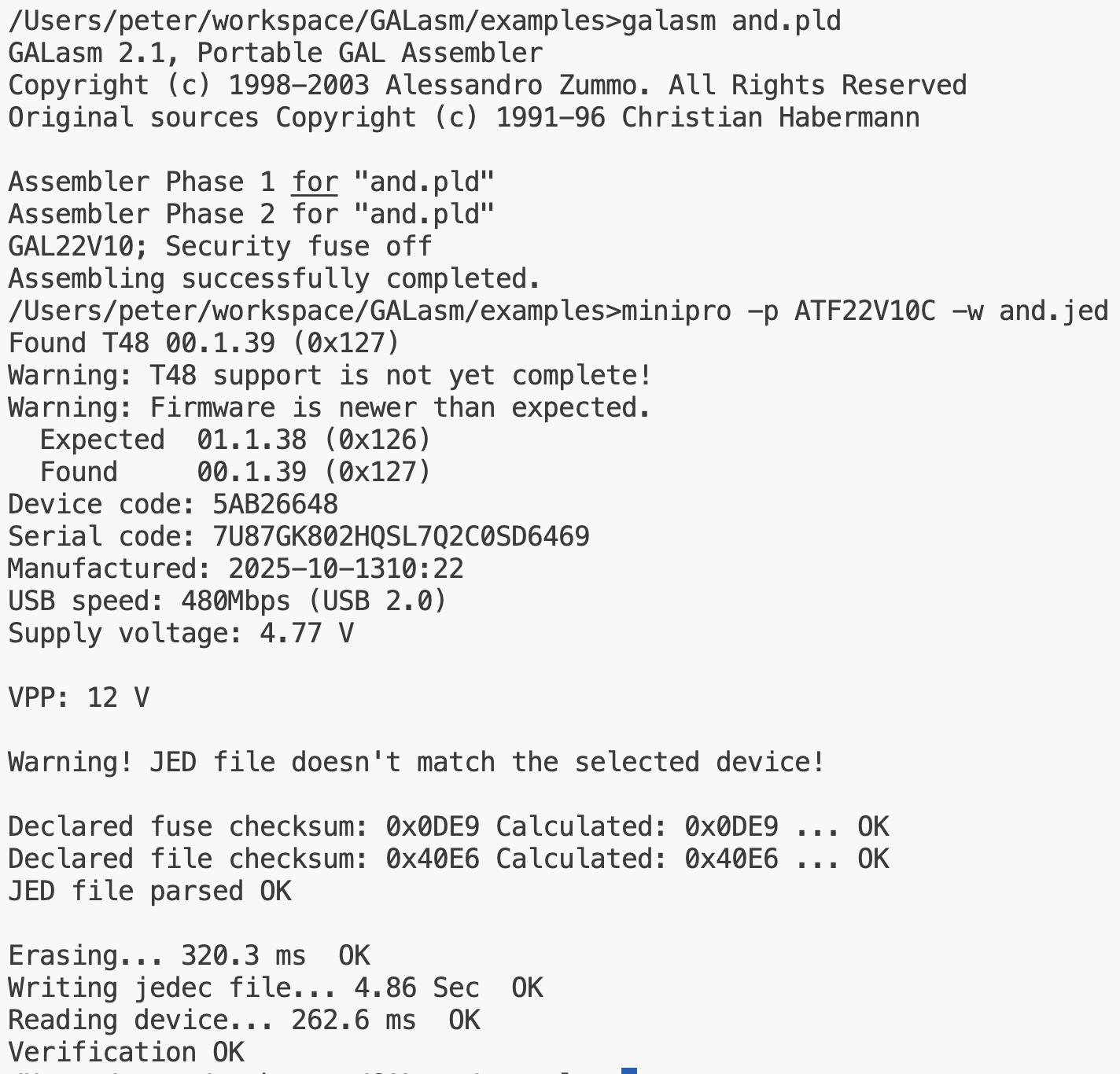
To read back the jed from chip, you can
minipro -p ATF22V10C -r output.jed
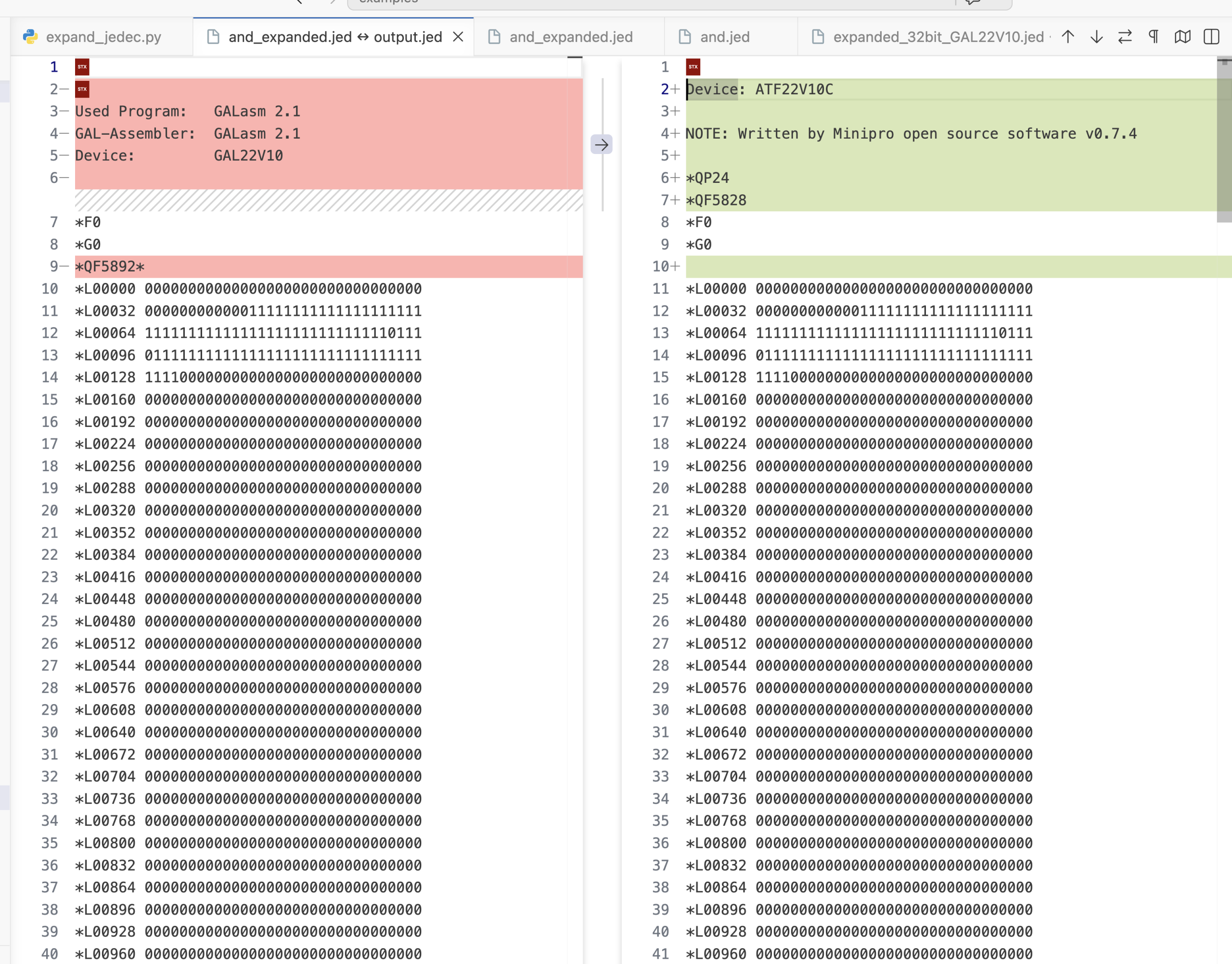
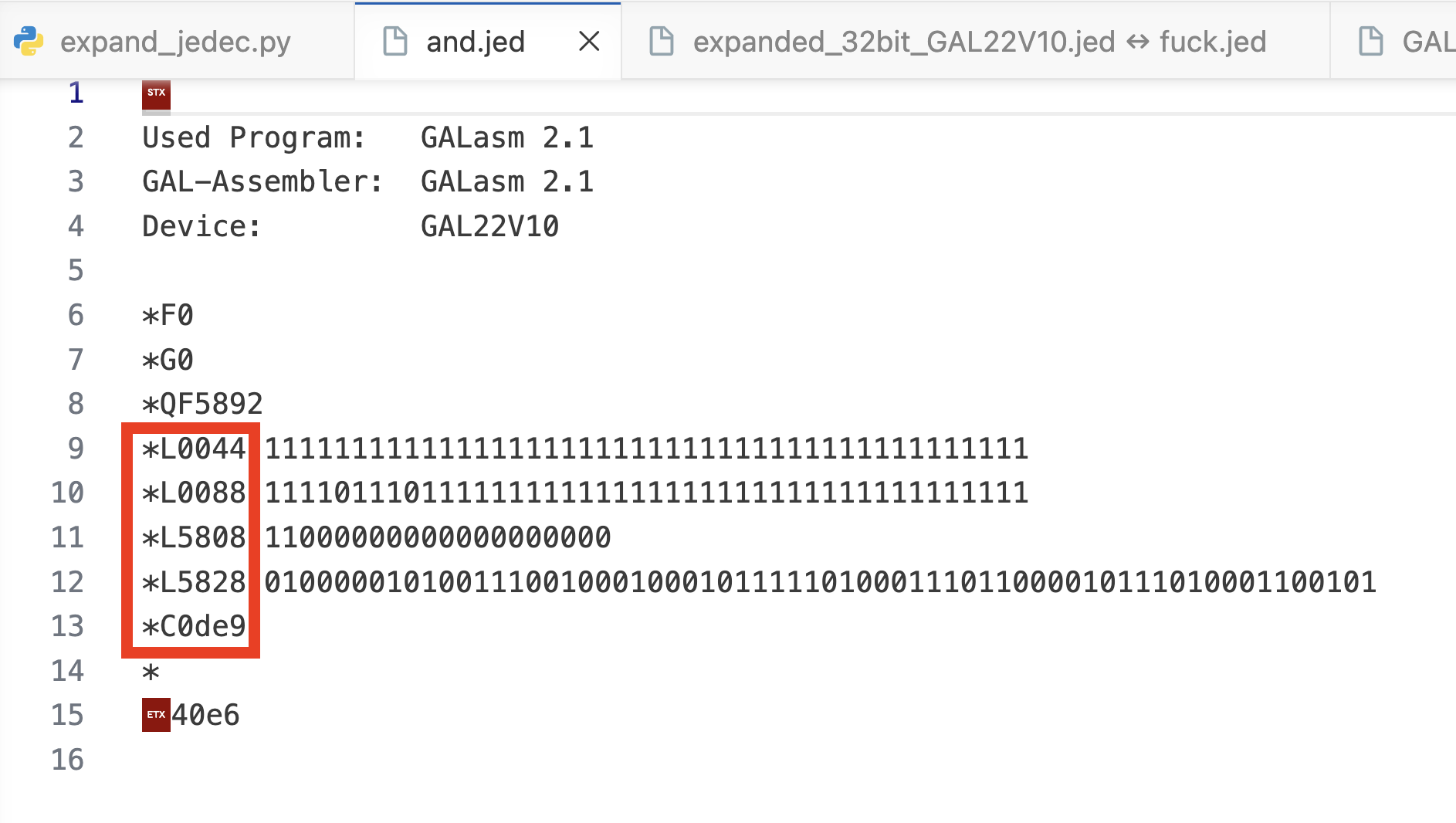
You can just compare the output.jed to your original and.jed, because and.jed is compiled by galasm and shortformed. I have a python to expand the jed, so the addresses in both jed files will be aligned.
See the address on left hand side then you see it is shortformed
import re
import sys

def expand_jedec_32bits(input_text):
    # 1. Determine default value from *F flag
    default_val = '0' if '*F0' in input_text else '1'

    qf_match = re.search(r'\*QF(\d+)', input_text)
    if not qf_match:
        raise ValueError("Could not find fuse count (*QF) field in JEDEC file.")
    total_fuses = int(qf_match.group(1))

    # 2. Initialize the entire fuse array with the default value
    fuse_array = [default_val] * total_fuses

    # 3. Parse and fill explicit allocation fields (*LXXXX)
    l_fields = re.findall(r'\*L(\d+)\s+([01\s]+)', input_text)

    for start_index_str, bit_string in l_fields:
        start_index = int(start_index_str)
        bits = bit_string.replace(" ", "").replace("\n", "").replace("\r", "")

        for i, bit in enumerate(bits):
            if start_index + i < total_fuses:
                fuse_array[start_index + i] = bit

    # 4. Calculate Fuse Checksum (Sum of all 8-bit fuse bytes)
    fuse_checksum = 0
    for i in range(0, total_fuses, 8):
        byte_bits = "".join(fuse_array[i:i+8])
        if len(byte_bits) < 8:
            byte_bits = byte_bits.ljust(8, '0')
        # Standard JEDEC checksum mirrors the bit order of each byte
        byte_val = int(byte_bits[::-1], 2)
        fuse_checksum = (fuse_checksum + byte_val) & 0xFFFF

    # 5. Construct the Longform Output Body (Row width = 32 bits)
    output_lines = []

    # Grab everything before the QF tag to keep original headers/comments
    header_end_idx = input_text.find('*QF')
    output_lines.append(input_text[:header_end_idx].strip())
    output_lines.append(f"*QF{total_fuses}*")

    row_size = 32  # 32 bits per row configuration
    for addr in range(0, total_fuses, row_size):
        chunk = fuse_array[addr:addr+row_size]
        chunk_str = "".join(chunk)

        # Append row format: *L<address> <bits>*
        # Keeping a space here as it is standard formatting for readability
        output_lines.append(f"*L{addr:05d} {chunk_str}")

    # Add the generated fuse checksum
    output_lines.append(f"*C{fuse_checksum:04X}*")

    # End of text transmission block
    output_body = "\n".join(output_lines) + "\n\x03"

    # 6. Calculate File Checksum (ASCII sum from STX to ETX)
    file_checksum = sum(ord(c) for c in output_body) + 0x02  # Include STX (0x02)
    file_checksum &= 0xFFFF

    final_jedec = f"\x02\n{output_body}{file_checksum:04x}"
    return final_jedec

# --- Execution ---
if __name__ == "__main__":
    if len(sys.argv) < 2:
        print("Usage: expand_jedec.py <input.jed> [output.jed]")
        sys.exit(1)

    input_file = sys.argv[1]
    output_file = sys.argv[2] if len(sys.argv) > 2 else input_file.rsplit(".", 1)[0] + "_expanded.jed"

    try:
        with open(input_file, "r", encoding="ascii") as f:
            shortform_data = f.read()

        longform_jedec = expand_jedec_32bits(shortform_data)
        with open(output_file, "w", encoding="ascii") as f:
            f.write(longform_jedec)
        print(f"Success! Generated '{output_file}' with 32-bit width arrays.")
    except FileNotFoundError:
        print(f"Error: Input file '{input_file}' not found.")
        sys.exit(1)
    except Exception as e:
        print(f"Error expanding JEDEC map: {e}")
        sys.exit(1)
run "python expand_jedec.py and.jed", then you got and_expand.jed, then you can diff and_expand.jed and and.jed to provide they are the same, so the program you burn to ATF22V10C are same as what you want (and.jed)