Filters and Power Converters in Electronics – A Brief Overview
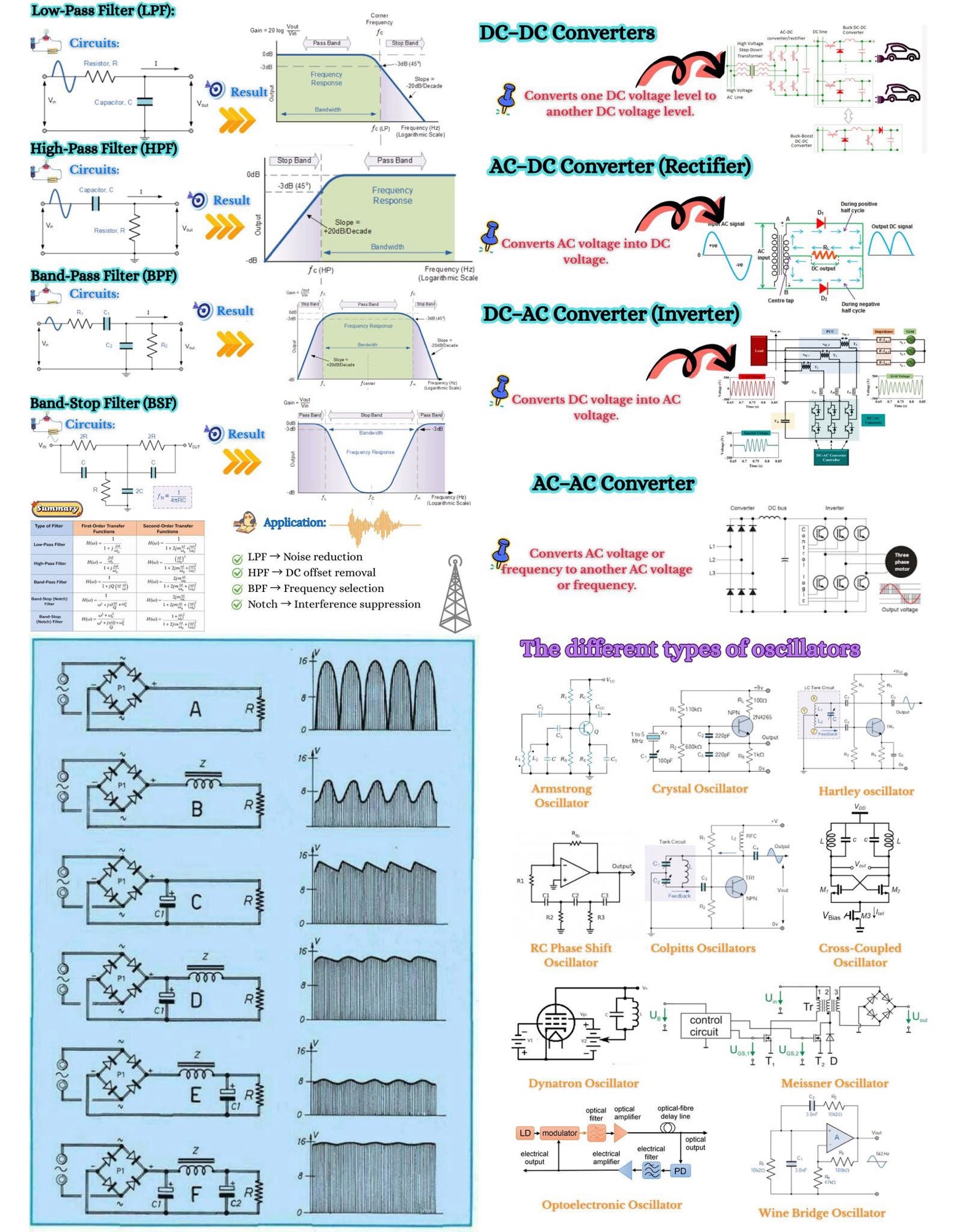
In analog electronics, frequency-selective filters are essential building blocks for signal processing. The low-pass filter (LPF) allows low frequencies to pass while attenuating higher ones, making it ideal for noise reduction. Conversely, the high-pass filter (HPF) blocks low frequencies (including DC offset) and passes higher ones. Band-pass filters (BPF) permit only a specific range of frequencies to pass, useful for frequency selection in communication systems, while band-stop/notch filters (BSF) suppress a narrow unwanted frequency band (e.g. 50/60 Hz hum interference). These first- and second-order RC/RL/RLC circuits exhibit characteristic -20 dB/decade or -40 dB/decade roll-off beyond their corner/cutoff frequencies.
On the power electronics side, static converters enable efficient transformation between different voltage types and levels. AC-DC converters (rectifiers) transform alternating current into direct current, forming the front-end of most power supplies. DC-DC converters (such as buck, boost, buck-boost, etc.) step up or step down DC voltage levels and are ubiquitous in battery-powered devices, electric vehicles, and renewable energy systems. DC-AC converters (inverters) convert DC (from batteries, solar panels, or DC links) into AC, powering AC motors, grid-tied solar systems, and uninterruptible power supplies. Finally, AC-AC converters (direct or indirect via DC link) allow voltage magnitude and/or frequency transformation, commonly used in motor drives and power transmission.
Together, these two domains — precise signal filtering and high-efficiency power conversion — form the foundation of modern electronics, spanning audio processing, RF communication, renewable energy systems, electric transportation, and industrial automation.